
Education Strategy

apple, books, classroom, red apple, fresh apple, fresh fruit, ripe, ripe apple, stack of books, delicious, fruit, apple, apple, apple, apple, apple, books

5 Ways to Facilitate Learning and Incorporate Sensory Language In Your Lesson Plans

5 Ways to Facilitate Learning and Incorporate Sensory Language In Your Lesson Plans Why is a strengths based approach to learning important? Traditional teaching strategies start many times from a deficit model. It is important to know where students are starting from and what they still need to learn. But the two aren’t mutually exclusive. Knowing where a student is starting from, what their life experiences have been, and what the passions and interests of learners are will help you to better partner with students in their learning process, will help students embrace this process with passion, and will help to facilitate student ownership and agency so that students openly embrace becoming life-long learners.  How can I help students overcome fear of failure? You can help students overcome their fears of failure by helping them to see failure as a worthy part of the learning process and progress as worth celebrating. Strategies that can help with this involve elements like embracing the role of the classroom as community, encouraging learner agency and ownership, and highlighting the practical ways failures have led to successes throughout history.  How does dialectical journaling help students build sensory language skills? Practice unlocks ability. Dialectical journaling helps students explore sensory language and the mechanics associated with its vocabulary in a setting where they’re not experiencing sensory overwhelm. This can facilitate student agency so that when they’re in a setting where they’re more likely to experience sensory overwhelm, they’ll be more likely to be able to use this language.   Traditional teaching strategies start many times from a deficit model. It is important to know where students are starting from and what they still need to learn. But the two aren’t mutually exclusive. Knowing where a student is starting from, what their life experiences have been, and what the passions and interests of learners are will help you to better partner with students in their learning process, will help students embrace this process with passion, and will help to facilitate student ownership and agency so that students openly embrace becoming life-long learners.  You can help students overcome their fears of failure by helping them to see failure as a worthy part of the learning process and progress as worth celebrating. Strategies that can help with this involve elements like embracing the role of the classroom as community, encouraging learner agency and ownership, and highlighting the practical ways failures have led to successes throughout history.  Practice unlocks ability. Dialectical journaling helps students explore sensory language and the mechanics associated with its vocabulary in a setting where they’re not experiencing sensory overwhelm. This can facilitate student agency so that when they’re in a setting where they’re more likely to experience sensory overwhelm, they’ll be more likely to be able to use this language.   Sensory language is defined as language that focuses on the senses, specifically senses like sight, smell, taste, touch, and sound. Through this kind of language, learners are able to experience stimuli both real and imagined. For those with Sensory Processing Sensitivity, there is a familiarity with the weight of experience. However, there may be a block in the ability to communicate this with you as the educator or with others in the learning environment. As an educator, you can help facilitate agency by incorporating sensory language into your lesson plans and classroom instruction. In ways that elevate learning for all of your students. Here’s how. Use Clear and Direct Language to Communicate Instructions to Learners. Ambiguity in instructions can add to sensory overwhelm and make it more difficult for sensory-sensitive learners to engage in class. Using language that is clear and direct helps to lower the barrier to entry so that every learner has an opportunity for success. Life happens. Prepare for those moments with partnership. As an educator, your goal is to be clear in your instructions. But it can be difficult to achieve this goal with the appearance of barriers like the fast pace of the school year, the rapid and systemic changes that can happen in the course of that year, and societal changes that affect the emotional regulation of students. Life happens. This is why having support both personally and professionally is important. Personal support can help reduce or overcome burnout. Click here to open a new tab and unlock 12 Mindset Shifts to Help You Overcome the Symptoms of Burnout. Professional support can help you to achieve your professional goals, provide you with accountability in achieving them, and help you to face the rapid pace of change head-on. Encourage Confidence in Learners by Building from Strengths. Learning is an objective. This means that it requires a clear strategy to accomplish effectively. Deficit models don’t account for this. Instead, they focus primarily on what’s missing from the equation. For sensory-sensitive learners already experiencing anxiety or even fear, deficit models feed into the potential for sensory overwhelm. For all students, this sets the groundwork for insecurity and negative peer pressure. Adapting your class instruction style so you focus on the strengths of your students and develop an ecosystem of partnership and accountability and that embraces the philosophy that any student, given the right helps, resources, and opportunities, can learn is vital for achieving the objective of student learning. Instead of focusing on learning from the starting point of deficit, building from the strengths of learners mean that you as the educator open the door for getting to know your students better by finding out what their passions are and where they are already as learners as compared to where they should be and using that solid foundation of what they know, enjoy, and have experienced and become familiar with to help guide the path forward for what the learning process could look like for each learner. The National Education Association provides an example of what this looks like for English Language Learners. Click here to open a new tab and read that article. While this article is about language learning. It provides insights

5 Ways to Facilitate Learning and Incorporate Sensory Language In Your Lesson Plans Read More »
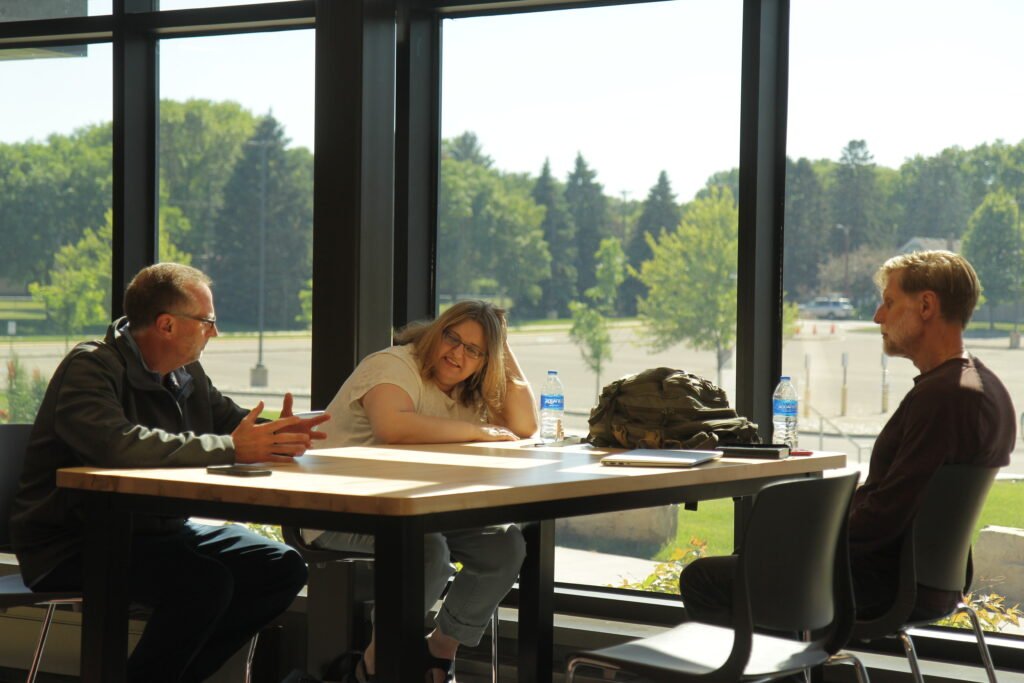
Three people sit at a table in front of a floor-to-ceiling window. Sensory-sensitive learners can achieve more through partnership, facilitation of agency, and strengths-based learning strategy.

5 Ways Sensory Processing Sensitivity Affects Learning

5 Ways Sensory Processing Sensitivity Affects Learning What is Sensory Processing Sensitivity? Sensory Processing Sensitivity, also known as SPS is what happens when the fight-flight-or-freeze response is triggered as a result of exposure to certain stimuli or a number of stimuli within a timeframe that the learner doesn’t have time to process. This sensitivity has real implications for student learning and information processing. Teachers can help sensory-sensitive students by emphasizing partnership with each student, facilitating the building of agency, and building from learner strengths. Which learners are affected by SPS? Any learner can experience Sensory Processing Sensitivity. It is also common with those whose experiences include neurodevelopmental and psychiatric conditions like: developmental delays, ADHD, Bipolar, and ASD.  As an educator, what can I do if students are having difficulty with expressing their experience of sensory overwhelm? The importance of listening to both verbal and nonverbal communication is vital to your partnership with all students, including those with Sensory Processing Sensitivity. You can also work with students to build their sensory vocabulary through strategies like the ones mentioned in this article from The Ruth and Scott Podcast Blog. Click here to open the article in a new tab.  Sensory Processing Sensitivity, also known as SPS is what happens when the fight-flight-or-freeze response is triggered as a result of exposure to certain stimuli or a number of stimuli within a timeframe that the learner doesn’t have time to process. This sensitivity has real implications for student learning and information processing. Teachers can help sensory-sensitive students by emphasizing partnership with each student, facilitating the building of agency, and building from learner strengths. Any learner can experience Sensory Processing Sensitivity. It is also common with those whose experiences include neurodevelopmental and psychiatric conditions like: developmental delays, ADHD, Bipolar, and ASD.  The importance of listening to both verbal and nonverbal communication is vital to your partnership with all students, including those with Sensory Processing Sensitivity. You can also work with students to build their sensory vocabulary through strategies like the ones mentioned in this article from The Ruth and Scott Podcast Blog. Click here to open the article in a new tab.  Sensory Processing Sensitivity is a topic that’s gaining more traction. More research is being conducted. Individual learners are trying to put their lived experience into context. But what does this mean for classroom instruction? How can you, as a teacher, meet your students where they are? Here are 5 ways SPS affects learning. Some Things to Know About Sensory Processing Sensitivity Before We Start A common misconception is that Sensory Processing Sensitivity only affects people with Autism Spectrum Disorder (ASD). While people with ASD may also have SPS, this sensitivity affects those with ADHD, certain learning disorders, Bipolar Disorders, and others not facing psychiatric or neurodevelopmental challenges.  Sensory Processing Disorder affects the lives and experiences of learners across the board. Click here to open a new tab and open this article by the Cleveland Clinic that talks more about Sensory Processing Sensitivity. Sensory Processing Disorder affects the lives and experiences of learners across the board. Before we continue with this conversation, here’s something else you need to know: SPS doesn’t look the same in every situation and for every student. Because of this partnership is one of the most vital elements of your toolkit. What this looks like depends on the learners you’re working with. For younger learners, this partnership starts with parental involvement. It may also include occupational therapists. At every level, you can bring along with you on your journey to best serve your students, admins, and possibly even community advocates, though the shape of this involvement may also vary based on the learners you work with. You also need to know that your work with students with SPS, as with each of your other students, is a process of continual learning and growth. These 5 points will help to get you started on this journey. Overwhelming Sensory Load Can Mean Students Aren’t Able to Focus on Learning Materials One way to think about Sensory Processing Sensitivity is like you would think about an allergic reaction. Your body is having an overreaction to what could, to some people, be harmless. To others, that same thing could evoke a sneeze on one end, or on the other end, be deadly. For someone with SPS, a stimulus could be mildly annoying. It could also be much more than that. But, just like when you’re having an allergic reaction and the itchy eyes and runny nose interfere with your attention and learning, a similar thing can happen when a student with SPS engages with classroom instruction. An Overwhelming Sensory Experience Can Lead to Overwhelm and Exhaustion That was Sensory Processing Sensitivity and its similarity to an allergic reaction. But let’s talk more about what it actually is. A stimulus is introduced, and the body goes into fight-flight-freeze mode. The body’s fighting in response to SPS can look like an emotional overreaction, and it could look like a learner looking for certain stimuli as though its experience is a craving. Freeze could look like delays in response time after a stimulus has been introduced. But the responses can be even more varied than this. When a sensory experience is overwhelming, the result can be an active reaction that leads to exhaustion. Experiencing this as a younger learner is something that can be helped by the formal organization of the day that includes a nap time. This isn’t the case when a learner is in more advanced grades. But it’s still important for learners to be able to withdraw for a time so that they can come back and re-engage in a way that actually facilitates learning. Your Student Might Not Have the Language or Vocabulary Available to Make Their Experience Understood In the article, 3 Breathing Exercises to Help with Emotional Regulation, one of the topics discussed is how intrapersonal communication can be complicated by internal noise. Click here to open that article in

5 Ways Sensory Processing Sensitivity Affects Learning Read More »

An empty classroom with arranged desks, exam papers, and pencils ready for students. Social entrepreneurship can be used by educators in the classroom to build agency in children.

Social Entrepreneurship and Partnership, Two Gamechangers in Building Childhood Agency

Social Entrepreneurship and Partnership, Two Gamechangers in Building Childhood Agency According to the EYLF Framework, what are the 5 learning outcomes? Identity Connection and contribution Wellbeing Confidence and involvement Effective communication What are the 5 Ps of social entrepreneurship? Passion Purpose Plan Partner Profit What’s the 10-10-10 Rule for Kids The 10-10-10 Rule for Kids is a way to help kids think about things that can happen as a result of actions. It encourages kids to think about what might happen as a result of an action in the next 10 minutes, the next 10 months, and then the next ten years.  Identity Connection and contribution Wellbeing Confidence and involvement Effective communication Passion Purpose Plan Partner Profit The 10-10-10 Rule for Kids is a way to help kids think about things that can happen as a result of actions. It encourages kids to think about what might happen as a result of an action in the next 10 minutes, the next 10 months, and then the next ten years.  Children are well aware of the world around them. Stories in the news and conversations held by loved ones present these realities through a lens that’s filtered but still very much felt. What life experience has not yet taught children is that they can have agency. This article explores how parents and educators can partner together and use social entrepreneurship principles as a key to unlock agency and encourage innovation and the processing of complex emotions. The Early Years Learning Framework and What it Teaches About Childhood Education In 2009, Australia introduced the Early Years Learning Framework. The framework is marked by 5 learning outcomes that highlight the importance of safety, security, exploration, relationships, and identity to the learning environment. These 5 learning outcomes are: Identity: This outcome aims to ensure that young learners feel safe and secure and that they’re operating from a place where they’re confident in their strengths and what they can do. Connection and contribution: Young learners begin to understand ideas like what’s fair, relationships, and diversity. Wellbeing: Children begin to learn about physical and emotional health and resilience. Confident and involved: Kids begin to learn about physical and emotional health and resilience. Effective communication: Children begin to harness creativity for the goal of self-expression through symbols, language, and various other media. Social entrepreneurship can be used to teach the child about relationships and healthy and appropriate conflict-handling. In some ways, EYLF builds on Maslow’s hierarchy of needs, recognizing the needs that children have for safety and security before they’re able to learn. Social entrepreneurship can be taught in ways that build on this to encourage agency. For the child at this stage, social entrepreneurship can be used to teach the child about relationships and healthy and appropriate conflict-handling. Through modeling the desired behaviors, both parents and educators can work together to equip children for times in the future when conflict can arise and to self-advocate should the necessity for this arise in the course of this or other relationships. Social Entrepreneurship and Other Entrepreneurship Styles Four entrepreneurial styles surface in conversations about business. These are the small business entrepreneur, the scalable startup entrepreneur, the intrapreneur, and the social entrepreneur: Small Business: The small business leader has identified their what and that there’s a business opportunity that this what represents. For example, a lawyer who has spent time in the formal education system and in internships notices that there’s an opportunity for them to engage in private practice. Often, this is an entrepreneur with a small business entrepreneurial style. Scalable Startup: This entrepreneur has the same starting place as the small business owner, with a notable exception. Their vision is larger. They don’t just want one location. They see the opportunity for expansion and want to go for it. Intrapreneur: Expansion is also key to this entrepreneurial style. However, possibilities are discovered from inside of this framework that lend themselves to the innovation of products and services that will bring change to the marketplace and change the standard for others operating inside of it. Social Entrepreneurs: These entrepreneurs are present in society and in the world around them. They see a problem happening and are motivated to do something about it. Because of the nature of social entrepreneurship, it can be a helpful way for kids to process, in a healthy and holistic way, the challenges facing their community that they might not currently have the language to express. Social Entrepreneurship and Educational Outcomes Children are explorers by nature, identifying what is through experimentation, hands-on with reality. This natural draw toward testing to see what works and what doesn’t is at the heart of innovation, creating something new. As parents and educators, your approach to teaching innovation for kids will be guided by age-appropriate strategies that allow the child to continue to explore organically. This also means establishing clear boundaries to help children understand the difference between when it’s time for task orientation and when it’s time to engage in unstructured play. Parents and educators can partner to help establish and hold this boundary through setting strategic outcomes. For educators, measuring educational outcomes starts with the establishment of clear SMART goals for student learning and using those to guide the way curriculum is implemented. For example, an educational outcome set for K-5 readers in the state of Wisconsin involves students learning to have conversations about how a reader’s point of view might be different from the writer, a character in a specific reading, or even a narrator. This kind of educational objective can be brought to life through social entrepreneurship by helping students understand marketing personas that represent the people they’re looking to partner with in their community to work toward solving the problems they’re noticing that are resulting in these complex emotions and feelings of helplessness. As a parent, you’re in a unique position both in terms of responsibility and in terms of the way that you can support educational outcomes. Because of this, you

Social Entrepreneurship and Partnership, Two Gamechangers in Building Childhood Agency Read More »