
What Family Food Traditions Really Taught Me
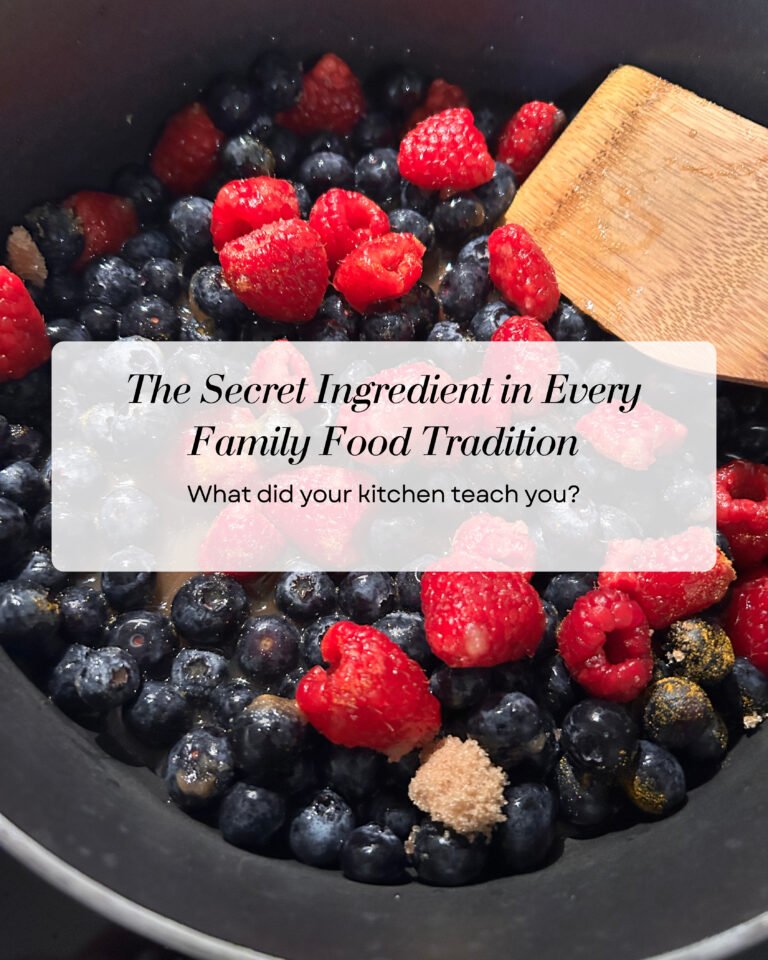
Why don’t older generations write down their recipes?
Recipes are generally and primarily passed down through observation and relationships instead of through more formal documentation. Cooking is a communal process. One way to think about this is in line with the picture/no picture debate. Is it more important to live this moment or to film it? For older generations, the response to the pressures and difficulties of life was to recognize the fleeting nature of the moment and to use that recognition to live more presently in it. This sometimes resulted in things like recipes not being written down.
Why are family traditions disappearing?
Family traditions are disappearing because the pressures of today (e.g., distance, technology, and the failure to prioritize connection) often result in questions about prioritizations of time. Time creates distance, which makes it difficult to pass on family traditions. If traditions aren’t passed on, eventually they’ll disappear.
How does family connection affect mental health and community?
The family is the nucleus from which communities are built. The relationships that occur within families are the first relationships that give you an idea about how to interact with people and how to move in space and time. When those roots are missing, a person might find themselves feeling rudderless. A person might find themselves struggling to understand who they are and where they come from. When you don’t understand the root of your own experience, it becomes difficult to have empathy for someone else’s struggles. Families that can’t connect lead to nations that can’t connect. The heart of mentorship and parental relationships is love. Listen to this episode of The Ruth and Scott Podcast as we talk about this and more.
“What is that?” I asked myself as I looked down and toward the stovetop at the pot that now stood empty except for the black spot at the bottom.
It took another second for me to reach toward the knob in front of me to turn off the burner. I don’t know how I did it. But somehow, on this day, the christening of my culinary journey, I had burned water. But then, my journey with food has always been a complicated one.
On one side of the family, I had a grandmother who catered events and had even written a number of cookbooks. On the other side of the family, I had a grandmother who was a deaconess but who also showed her love through food. One of her first actions any time we were together was to cook for me. One of her favorite things to cook for me, at least during breakfast time, was bacon. Another thing was sausage. I remember, as a young child, the smell wafting up from the cast-iron skillet, and the warmth both from the stovetop and the feeling of knowing I was loved.
That was the day I almost got kicked off of a mission trip. The reason? Challenging this advice. It was one of those situations where a student doesn’t have any knowledge of cultural competence because their learning environment doesn’t foster it. They hadn’t received that training from their learning experience. And, as far as their community (including their leadership) outside of that direct experience with teacher training, those with influence had similar backgrounds and also lacked that training. Because they didn’t have it, they didn’t recognize its importance. As a result, any challenge to that worldview was seen as a threat and a challenge. The only reaction they could think of to this perceived attack was to remove the threat to this comfort zone.
Then, there was the winding path my journey with food took through my middle school and high school years. There was actually a running joke in the house at that time that any Thanksgiving without some kind of minor fire was a miracle.
Before you ask? No. I didn’t start the fire. They were already burning before my own journey with cooking even got turning. But there’s definitely a difference between my burning water and the kind of cooking those closest to me know me for now (This includes my fried chicken, a recipe a friend affectionately calls fried Charlie.)—rooted in family food traditions, culture and history, a history of love that didn’t need to be written down because it was lived, and at the same time, an opportunity for me to be presently and completely me. Although the workload of cooking has definitely changed my process and frequency.
We Didn’t Lose the Recipe. We Lost the Kitchen.
There are a lot of things that have changed with food over the years, both for my own journey and, as I’ve observed, the journeys of others. The unfortunate fact? Some of these changes have caused more harm than we can even know at this moment in time.
When was the last time your journey with food took you into the kitchen?
Not just with food or those who live in the house with you? When was the last time food took you on a journey with family who don’t live with you or who may live a couple of states or even further away? You might try your hand at this on Thanksgiving, Christmas, or maybe, though possibly even less common, on Easter. But how about outside of that?
These kinds of connections aren’t as common anymore. This means that it’s less common to connect in the kitchen through food, to work through problems while scrubbing potatoes or smelling the strong and earthy, rich scent of greens cooked overnight on the stove or in the crockpot. The flavor of food was measured by the depth of connection that happened around it. Even when that connection was messy or painful or tasted more like canned cranberry sauce than it did buttermilk chess pie (I love y’all, but I said what I said.). Somewhere, as the importance of these relationships began to be displaced, so were recipes both for food and for life.
Food, Cultural Identity, and the Love That Holds It Together
Families that can’t connect lead to nations that can’t connect. Nations that can’t connect lead to the kinds of abuses we’re seeing around us even today. They’re not new, but they are amplified through distance, through technology, through the failure to realize that the secret to any good recipe starts with working through the steps one at a time, guided by love. Love is the throughline, whether cookbooks are more your style or you’re more of a chef guided by a connection to faith and food that’s more of an immersive vibe.
Sure, the teacher could’ve probably told those students to sit down and shut up. But it wouldn’t have really been instructional because they would have had an understanding of the why. And context and understanding are just as important as the rules they’re used to enforce.
As a stranger to the educational environment where you have formal influence, new students carry with them their own context. Your ability to engage with them there, in helpful ways, makes a big difference.
Greetings, this is extremely valuable!! Thanks for this info. Looking forward to your next post!